
Hades
Every Death Moves the Story Forward
Roguelike ‧ Supergiant Games ‧ PS4 ‧ 2020 ‧ 8 min read
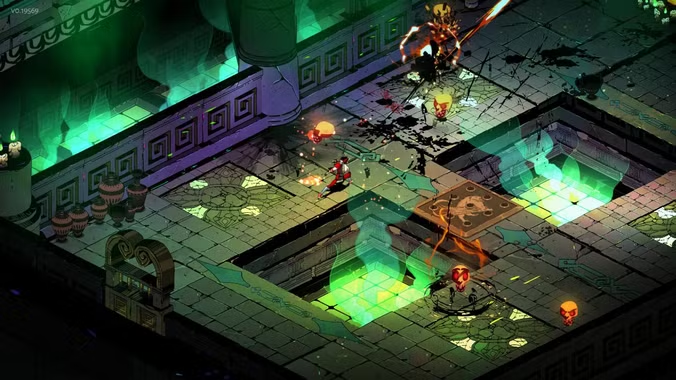
"The House of Hades has stood since long before your birth, and it shall remain long after your last escape attempt."
Hades is a game about a young man named Zagreus who is trying to escape the Underworld. It belongs to a genre called the roguelike, which means that every time he dies — and that will happen constantly, especially at first — he wakes back up at the start and has to try again. That description alone is enough to make most people close the tab, because dying over and over and being sent back to square one sounds like punishment rather than play. In most games that use this structure, it genuinely is. What Supergiant Games understood when they made Hades is that the only way to make that loop feel meaningful is to make each death matter to the story, not just your score. The way they pulled that off is the reason this game is worth talking about even if you've never played a roguelike in your life and have no intention of starting.
Zagreus is the son of the god of the dead, raised in the House of Hades deep beneath the earth, surrounded by shades and monsters and gods who all have opinions about his situation. He wants to reach the surface and find his mother, who left the Underworld before he was old enough to know her. His father, the god Hades himself — cold, exacting, unwilling to explain anything — is not going to help him get there. Every run through the Underworld is an attempt to fight past four increasingly difficult regions: Tartarus, Asphodel, Elysium, and the Temple of Styx. When you die, you return to the House, where the characters you passed on the way remember what happened and have new things to say about it. Your relationships with all of them inch forward depending on how many times you've come back to have these conversations. The story does not happen between the runs and the gameplay, the way most games with this structure handle it. The story is the runs and everything that follows each one, woven together so seamlessly that stopping to notice how it works slightly breaks the spell.
The combat is fast, precise, and built around six very different weapons: a sword, a spear, a bow, a shield, twin fists, and a gun. Each can be further modified by four unlockable Aspects that change how the weapon fundamentally behaves, so even once you've played the same weapon a dozen times, there are variants you may not have touched yet. On top of the weapon, the Olympian gods offer upgrades called Boons at the start of each room you clear, and these stack and interact with each other in ways that create different builds across every single run. You might come in with a build focused entirely on creating massive explosions with the sword, and the next run you might accidentally stumble into a build centered on slowing enemies down and drowning them in status effects — both feel like complete, intentional ideas rather than random luck. The Keepsake system, where you equip a token given to you by a specific character, lets you guarantee an early Boon from a god of your choice. That gives you just enough control over the randomness to pursue a build you had in mind, without removing the unpredictability that makes each run feel different from the last.
What makes the combat feel genuinely good rather than just functional is that each weapon has a distinct rhythm to it that takes real time to understand and rewards you for doing so. The shield in particular plays almost nothing like the sword — it has a block, the ability to be thrown and ricocheted off enemies, and one Aspect that turns it into something that plays like a completely different game. The learning curve on each weapon is steep enough that the game gives you good reasons to experiment rather than settle for the one that clicked first. The rooms themselves range from small arenas with a handful of enemies to large, chaotic spaces full of projectiles and specialized enemies that require you to think about positioning while also managing the moment-to-moment combat. The game is honest about the fact that the early regions are going to punish you for being careless before you've learned enough not to be.
The characters are the part of Hades that most people do not expect to care about and end up caring about the most. Achilles is stationed in the House as a trainer and speaks to Zagreus with the patience of someone who has watched a great many futile efforts and chosen to be useful anyway. His own story — the deal that keeps him bound to the House, what he sacrificed, what he's still waiting for — unfolds gradually across conversations that span dozens of runs. Megaera, one of the three Furies who appears as a boss at the end of Tartarus, has a complicated and charged history with Zagreus that the game reveals gradually, turning what would otherwise be a straightforward boss encounter into something considerably more interesting. Nyx, who raised Zagreus and knows things about his family she is not allowed to say, occupies the House as one of its most present and most carefully written figures. Even minor characters like Sisyphus, found in Asphodel still doing what Sisyphus does but in genuinely decent spirits about it, are given enough texture to feel like real presences rather than background dressing.
The music, composed by Darren Korb, is doing something that's hard to describe but immediately recognizable when you hear it — sitting somewhere between ancient Mediterranean folk and hard rock in a way that shouldn't work at all and completely does. It shifts register between the quiet moments in the House and the driving energy of combat with the same ease the game shifts between story and action. Eurydice, who you encounter in Asphodel as an optional room, sings you a short song and gives you a recovery bonus when you find her, and the few minutes in her chamber are genuinely the most peaceful the game ever gets — which makes returning to the chaos of the next room feel like a very specific kind of loss.
The one honest thing to say about Hades is that the early hours can feel discouraging in a way that requires some trust in the process. The first several runs will likely end in Tartarus, and even once you start making consistent progress through the Underworld, the jump in difficulty between each region is steep enough that reaching a new boss for the first time often means dying to it several times before you understand it. The game offers a God Mode for players who want the story without the frustration, gradually reducing the damage you take after each death — there's no shame in using it. But if you come in expecting immediate momentum, the early hours may push back harder than you're prepared for. It's also worth knowing that fully completing the story requires somewhere between twenty and forty successful escapes, depending on how quickly you pick up each weapon and how thoroughly you invest in the character relationships. This is not a game that gives you everything over a weekend.
What Hades ultimately earns is the thing that almost no other game in its genre manages: the feeling that dying was not a setback but a continuation. You come back to the House and you want to talk to Achilles before the next run, or you realize you unlocked a new Aspect overnight and want to try it, or a character said something last time that made you want to find out what happens next, and before long the attempts are not attempts at all, they are chapters. Hades earns a 5 out of 5, and if you have been curious about it but put off by the roguelike reputation, this is the one worth giving a chance.
(The moment you first successfully escape is one of the best things this console generation has to offer. Trust the process.)