
Ghost of Tsushima
The Samurai Is Gone. The Ghost Remains.
Action/Adventure ‧ Sucker Punch Productions ‧ PS4 ‧ 2020 ‧ 8 min read
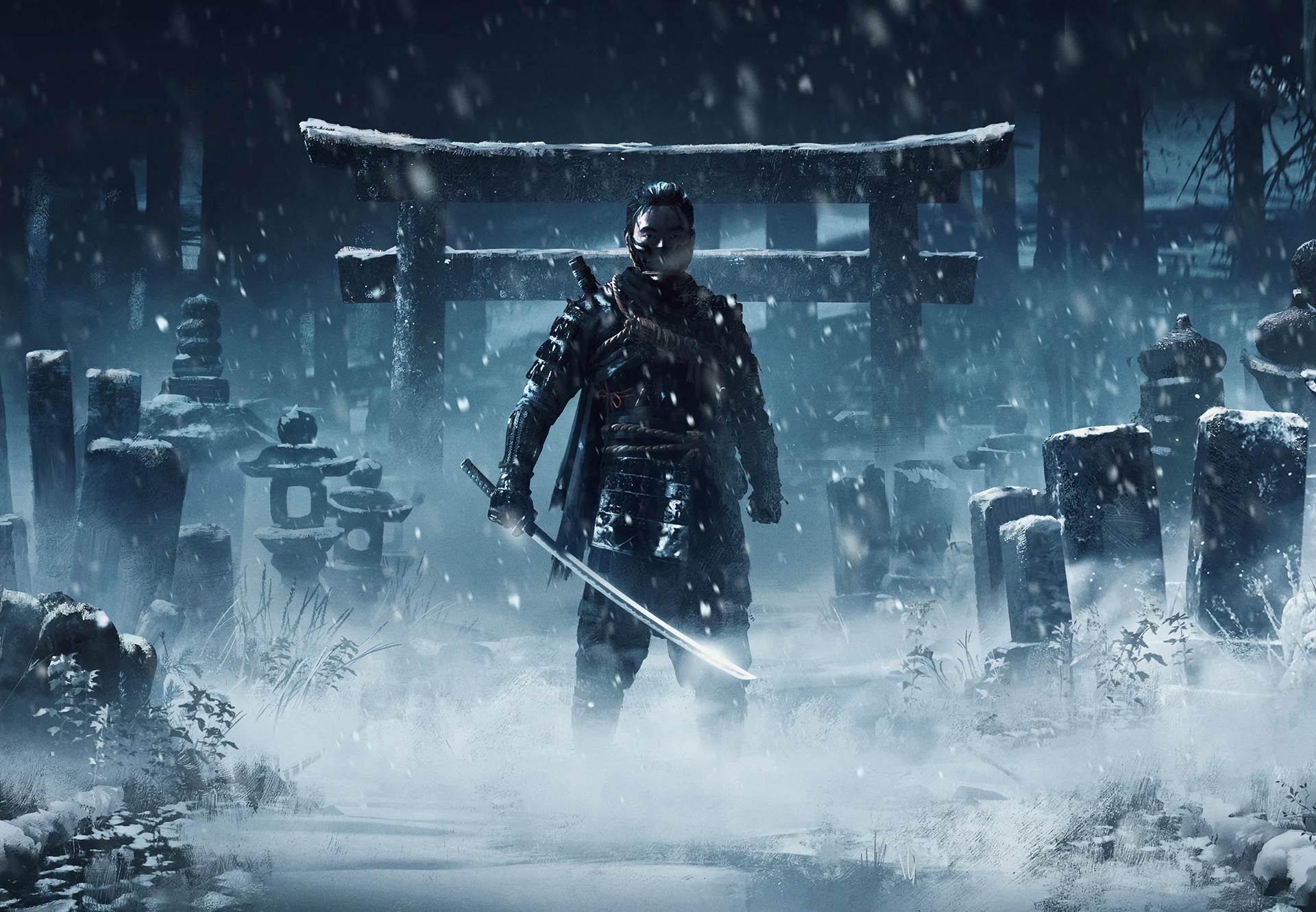
"A samurai who wears a mask to hide his shame is no samurai at all."
Ghost of Tsushima is set on the Japanese island of Tsushima in 1274, during the first Mongol invasion of Japan, and it opens with a battle that the samurai lose completely. They ride out to meet the invaders on the beach in open formation, wearing their armor and carrying their honor like a declaration, and the Mongols cut through them in minutes. The game's main character, Jin Sakai, survives only because he is left for dead in the grass while his uncle, Lord Shimura, is taken prisoner and the island begins to burn behind him. From that starting point, Ghost of Tsushima spends the next thirty to forty hours asking a single question that turns out to have no clean answer: what does a man do when the code he was raised on, which was the samurai's commitment to honorable, open combat, is the very thing that got everyone killed, and survival now requires becoming something his training would never permit? The way the game carries that question through to the end without losing its thread or flinching from its conclusion is what makes it one of the best open-world games made in the last decade.
The world is where most people start when they talk about this game, and for good reason, because Tsushima is one of the most visually stunning open worlds in gaming. The island is built out of pampas grass that moves in the wind, forests of red and gold, coastal cliffs above grey water, and mountain passes that open onto views the game is perfectly happy to let you stand in front of for as long as you want. What sets it apart from other beautiful open worlds is that the beauty is not just decoration, because the environment is how the game communicates with you. Rather than a minimap or a compass, you raise a finger and the wind bends toward your destination, carrying you through the world as a participant rather than a navigator following a UI element. It is the most elegant solution to open-world navigation that the genre has produced, and it disappears so completely into the fiction that after a few hours you stop thinking of it as a mechanic at all and start thinking of it as just the way the island works.
The combat is built around Jin's identity as a samurai, which means it starts from a foundation of swordsmanship, meaning parrying, dodging, and reading enemy attack patterns, and then gradually introduces the tools of the Ghost, the identity Jin builds for himself over the course of the story as a way to fight the Mongols that the samurai code would never sanction. As a samurai, you fight in stances, and the game gives you four of them, Stone, Water, Wind, and Moon, each designed to counter a specific type of enemy, and learning to read what you are facing and switch into the right stance before engaging is the core skill the combat asks you to build. The parry timing is tight enough to feel like an achievement when you get it right and forgiving enough that it does not turn into a frustration exercise, and the swords feel genuinely weighty in a way that makes every kill feel earned rather than automatic.
As the Ghost, Jin gains access to tools that his samurai training would consider dishonorable, including smoke bombs that let him vanish and reposition, kunai that stagger multiple enemies at once, a half-bow for picking off targets from distance, and a stealth system built around moving through tall grass and shadows that is satisfying enough that some encounters are worth attempting entirely without drawing your sword. The game never forces you to choose between the samurai and the Ghost, which is the right call because both halves of Jin's toolkit are genuinely useful and because the story handles the tension between them with enough seriousness that making the choice mechanically would feel like it was trivializing the narrative question. There is a move called the Ghost Stance that unlocks through the story, which allows Jin to kill a group of enemies so quickly and terrifyingly that the survivors freeze in fear, and using it for the first time in a crowded Mongol camp feels like exactly the kind of power it looks like on screen.
The standoff mechanic deserves its own mention because it is the single best idea in the game: at any point outside of an ongoing fight, you can approach a group of enemies with your sword sheathed, hold your ground as they surround you, and wait for one of them to draw first, at which point you cut down everyone who drew in that window before they can react. It rewards patience in a game about a character who was trained his entire life to wait for the right moment, it makes you feel genuinely dangerous in a way that pure button execution does not, and it is the purest mechanical expression of what Jin was before the Ghost and what he is trying not to lose as the Ghost takes over.
Khotun Khan, the Mongol commander who leads the invasion, is a villain who works because he does not underestimate the people he is conquering. He has studied the samurai, understands exactly what their code will and will not allow, and uses that understanding as a weapon against them, making his threat feel specific to this island and this conflict rather than generically menacing. The supporting characters Jin encounters across the island, including a disgraced archer, a wandering monk, and a woman searching for her kidnapped brother, each carry their own sidequests, and the Tales of Tsushima, as the game calls these optional story threads, are written with enough care that several of them would be worth playing even if they were the main content of a shorter game. The island rewards exploration not with collectible icons but with genuine discoveries, and stumbling onto a hidden shrine or a poet's campfire or a fox den in the middle of crossing from one objective to another is one of the most consistently pleasant things the game offers.
The final act asks what the whole game has been building toward, and the answer arrives in the form of a confrontation with someone whose presence in Jin's life the story has been quietly preparing you for since the opening scene. It is the most emotionally complete sequence in the game, and the choice the game puts in front of you at the end is not one that has a correct answer, which the game does not pretend otherwise. Both options carry a cost that the story has spent its full runtime making real, and the fact that you feel the weight of both is the sign that everything before it worked. Ghost of Tsushima earns a 5 out of 5, and if you finish the base game and want more, the Director's Cut adds an Iki Island expansion that brings a new villain and a deeper look at Jin's past that is genuinely worth the time.
(The haiku minigame, where you sit in a field and write short poems about the wind and the season, is the most peaceful thing on PlayStation 4 and is not even close.)