
God of War
Do Not Be Sorry. Be Better.
Action/Adventure ‧ Santa Monica Studio ‧ PS4 ‧ 2018 ‧ 8 min read
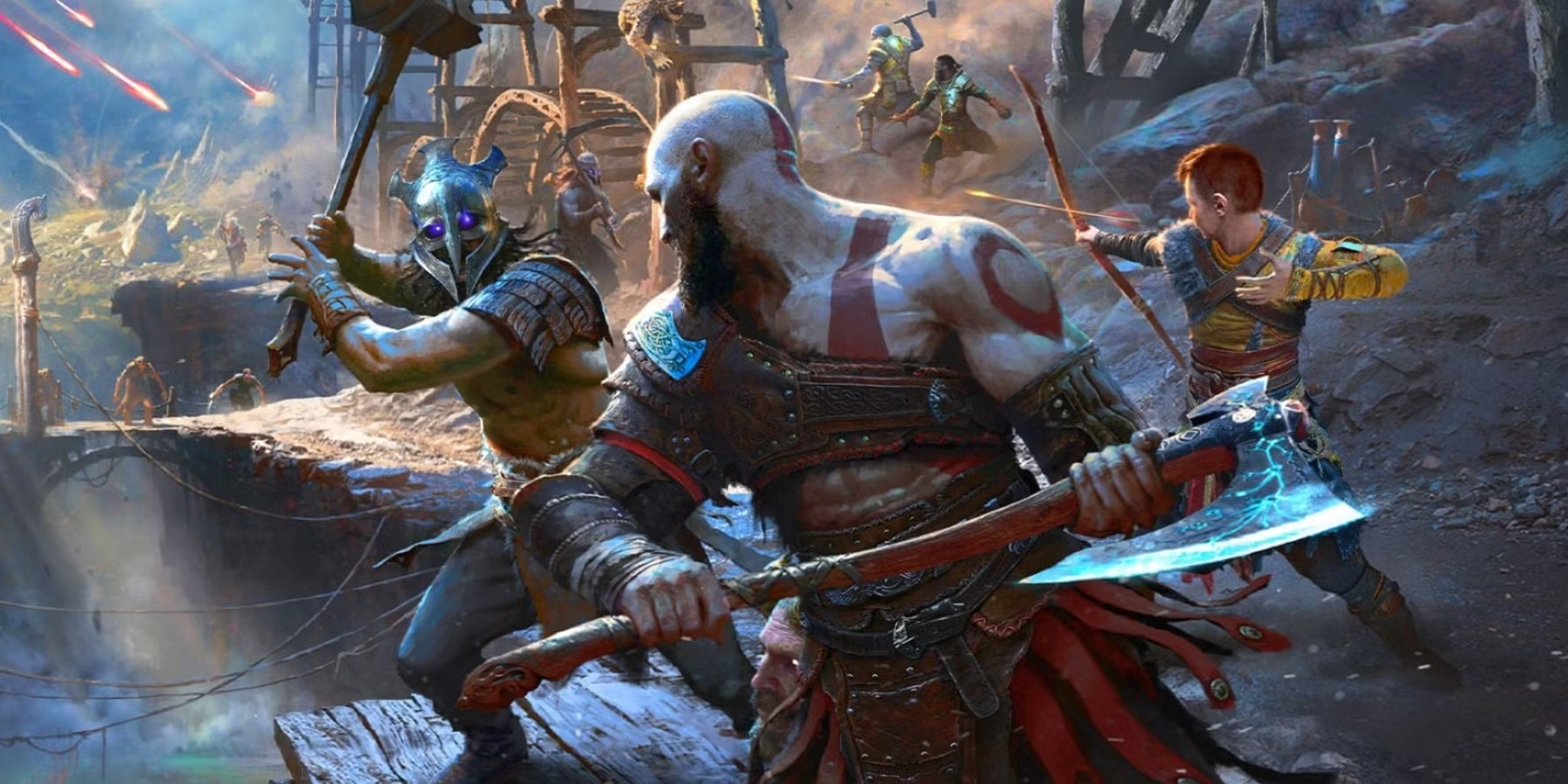
"Do not be sorry. Be better."
God of War is an action game about a man named Kratos who, in three previous games set in ancient Greece, killed every god he could find, including his own father Zeus, in an act of grief-fueled destruction that leveled an entire mythology. That context is not required to play this version, and the game is careful not to demand it, but it helps to know going in that the character you are playing is carrying the weight of everything he has done and has chosen a new world and a quieter life in the hope that geography might be enough to outrun consequence. It is not, of course, and the game begins on the morning of the funeral for Kratos's wife, with his young son Atreus standing beside him, and the two of them preparing to carry her ashes to the highest peak in the Norse realm as she requested. Everything that follows is a journey told through a father and son who do not yet know how to talk to each other, and the game earns more from that premise than most films earn from the same material.
The most striking technical decision Santa Monica Studio made with this game is that it is presented as a single unbroken shot, meaning the camera never cuts away, never fades to black, and never transitions between scenes in a way that breaks the continuity of the image. From the moment you pick up the controller to the moment the credits roll, the camera sits just behind Kratos's left shoulder and stays there, which creates an intimacy with the characters that most action games do not bother to attempt. When Kratos and Atreus speak to each other during combat, when Atreus asks a question and Kratos answers with less than he should, when a quiet moment between fights gives the two of them space to be something other than warrior and archer, and all of it happens without a cut, without a remove, and the effect accumulates over the course of the game into something genuinely affecting. Christopher Judge plays Kratos as a man who has learned to use silence as armor and is slowly, painfully being asked to put it down, and Sunny Suljic plays Atreus as a boy who wants his father's approval badly enough that the rare moments it comes feel enormous.
The combat is built around a weapon called the Leviathan Axe, which can be thrown at enemies with enough force to kill or stagger them and then recalled to Kratos's hand with a single button press, and the satisfaction of throwing it, watching it connect, and recalling it to your hand never diminishes across the game's full length, which is one of the harder things to pull off in any action game. The fights themselves feel physical in a way that the earlier games in the series, which were larger and more cinematic, did not quite manage, and the over-the-shoulder perspective that the new camera demands means that every encounter feels immediate and grounded rather than spectacular. Atreus fights alongside you in every encounter, firing arrows on command and responding to the battlefield intelligently, and the way the game integrates him into combat rather than reducing him to a liability is one of its best design decisions. Later in the game Kratos recovers a second weapon called the Blades of Chaos, his signature weapons from the Greek games, and the contrast between the two, the controlled weight of the axe against the wild chain-swinging of the blades, gives the combat a variety in its second half that keeps it from settling into repetition.
The Norse world the game is set in is built with a density and specificity that makes it feel inhabited rather than decorative, and the game is at its most purely enjoyable when it is letting you explore that world and discover what it has put inside it. The World Tree connects a series of distinct realms, including Midgard, Alfheim, Helheim, Muspelheim, and Niflheim, each with its own visual identity and its own mythology, and the game populates them generously with optional encounters, hidden stories, and environmental detail that rewards curiosity. Mimir, a character you acquire early in the game who is, for reasons the story explains, just a severed head attached to Kratos's belt, fills every travel section with Norse mythology lore and personal stories told with dry wit and genuine warmth, and his dynamic with Kratos, a man who has no patience for extended conversation, is one of the consistent pleasures of the entire game.
Freya, a powerful figure who becomes an unexpected ally early in the story, is the game's most emotionally complicated thread, and her arc across the second half of the game handles her transformation from genuine warmth to something much harder with enough care that it registers as a real loss rather than a plot maneuver. Baldur, the game's primary antagonist, works because his motivation is comprehensible rather than purely villainous, being instead a god who has been cursed to feel nothing, not pain, not pleasure, not cold, and his rage at everything around him is the rage of someone who has been suffering in a way that no one around him can see. His confrontations with Kratos are among the best action sequences in the game, and the final one earns its emotional dimension through everything the story has built before it.
Where the game loses some of its momentum is in the middle section, centered around the Lake of Nine, which functions as the game's hub area and which you will return to repeatedly as the story sends you between realms. The returns start to feel like maintenance after a while, and the optional content available in the lake's surrounding areas, including challenge arenas in Muspelheim and resource-gathering corridors in Niflheim, exists for players who want to upgrade their gear to its maximum capacity but reads more as checklist completion than as content that adds anything to the experience. There is also a stretch in the story's second act where the momentum stalls and the game cycles through what amounts to errand-running before it recovers the pace it had in its first half, and a tighter edit in those sections would have made the overall experience feel more consistently urgent.
What stays with you from God of War, though, is not the combat or the Norse world or even the unbroken shot, but rather the moment, late in the game, when the distance between Kratos and Atreus finally closes in a way neither of them expected, and the way the camera simply holds on both of them while it does. The game has been earning that moment for twenty hours, and it pays off in a way that the genre rarely manages. Bear McCreary's score, quiet and searching during the personal scenes and genuinely grand when the story asks for it, closes the game on something that feels complete without pretending everything has been resolved. God of War earns a 4.5 out of 5, and the sequel, Ragnarok, picks up directly where this leaves off and is worth playing the moment you finish it.
(The final scene between Kratos and Atreus is the most effective two seconds this console generation has to offer.)