
Watchmen
Who Watches the Watchmen
DC Comics ‧ Issues #1–12 ‧ 1986–1987 ‧ Alan Moore / Dave Gibbons ‧ 9 min read
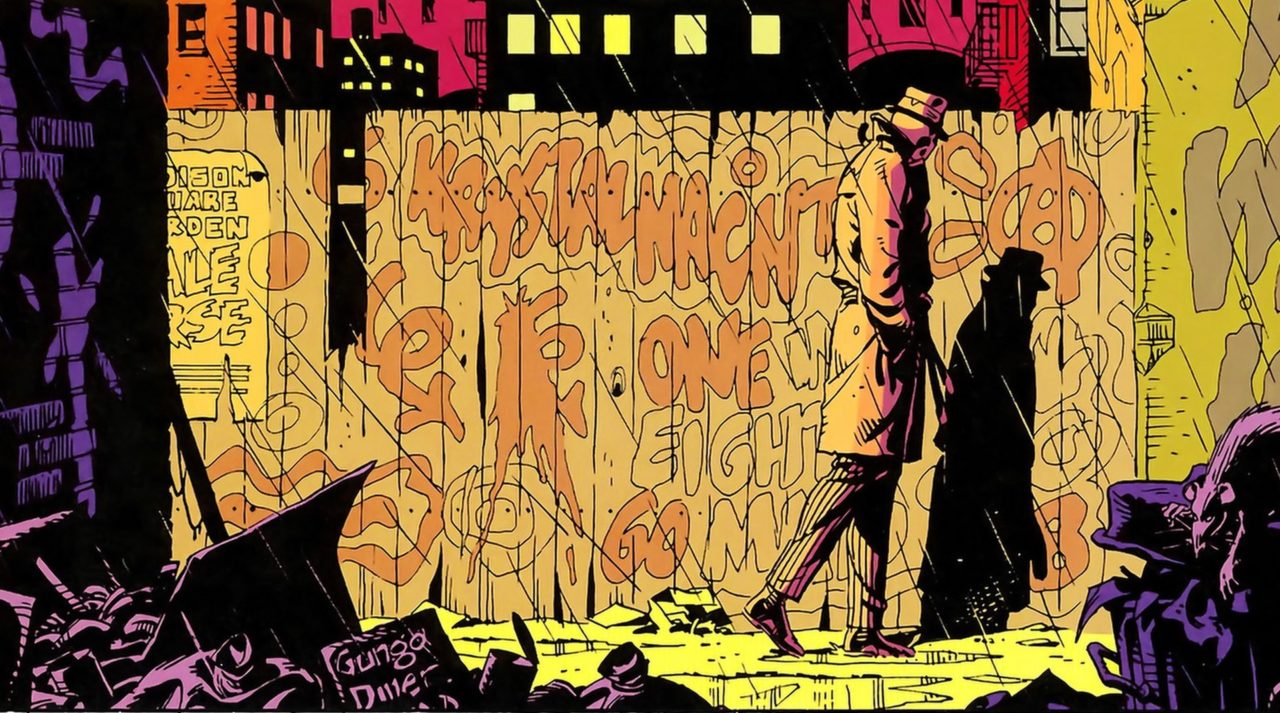
"None of you understand. I'm not locked in here with you. You're locked in here with me."
Watchmen operates as a superhero story and as a sustained interrogation of one at the same time, and what Alan Moore and Dave Gibbons understood is that those two things do not have to be in conflict. The series ran for twelve issues, published by DC Comics between 1986 and 1987, set in an alternate version of 1985 where costumed vigilantes have existed since the 1940s, where the United States won the Vietnam War, where Richard Nixon is still president, and where the world is sitting at the edge of nuclear annihilation with a specific dread the real 1985 was also living through, though with less honesty in the popular conversation about it. Moore and Gibbons built that world with a specificity and a density that rewards close reading, and the twelve issues contain more ideas about power, identity, and moral compromise than most novels that run three times as long.
The story begins with the murder of a retired costumed vigilante called the Comedian, and it follows the investigation by Rorschach, a current vigilante who operates in defiance of a law that outlawed masked crime-fighting a decade earlier. Through that investigation, the series expands outward to touch the lives of four other former heroes: the mild-mannered Night Owl II, who misses the clarity that came with the costume; the Silk Spectre II, who inherited the role from her mother and is still sorting out what she actually chose and what was chosen for her; Ozymandias, the smartest man in the world who retired voluntarily and turned his attention to solving the world's problems through legitimate means; and Dr. Manhattan, a physicist who was disintegrated in a laboratory accident in 1959 and rebuilt himself at the quantum level into something that is technically human and functionally a god. Each of these characters is examined with a psychological honesty that the genre had never attempted before, and the ensemble structure means that by the time the story reaches its conclusion, the reader has spent enough time inside each of their perspectives to understand how reasonable people can arrive at deeply incompatible positions.
Dr. Manhattan is the most genuinely extraordinary superhero ever written, and what makes him so is not his power but Moore's willingness to follow the implications of that power to their logical end. A being who exists outside of time, who experiences past and future simultaneously, who can see the molecular structure of everything around him, who does not need to eat or sleep or feel cold, is not going to relate to human experience the way a human does, and Moore does not pretend otherwise. The chapter told entirely from Manhattan's non-linear perspective is one of the most formally inventive pieces of comic writing ever produced, and it lands as something genuinely moving despite, or perhaps because of, its central character's increasing detachment from the things that would normally generate that emotion.
Dave Gibbons's art is so precisely calibrated to Moore's script that it is easy to take for granted how much of the book's meaning is carried entirely through the images. Gibbons works almost exclusively in a nine-panel grid across the twelve issues, and the discipline of that structure creates an effect that is simultaneously restrictive and endlessly expressive, because within that grid he can control exactly what you see in each panel and exactly how long you spend with it before the story moves on. The fifth issue, which is built around a strict symmetry where the panels in the first half mirror the panels in the second, is the most formally accomplished single issue in the entire run, and it communicates its themes through structure as clearly as through its dialogue. The color work by John Higgins is equally deliberate, with specific hues tied to specific characters and emotional states throughout the run.
Rorschach is the character most people come away from Watchmen thinking about, and that is partly by design and partly a problem the book is self-aware enough to acknowledge. His journal provides the narration for much of the series, and Moore writes it with an immediacy and a voice that is compelling in direct proportion to how troubling its contents are. Rorschach's moral absolutism, his view of the world as either black or white with nothing in between, is presented as both the source of his effectiveness and the precise measure of his damage, and the book does not resolve that tension so much as hold it open for the reader to sit with. That he became the most recognized character in a story full of more conventionally sympathetic figures is not an accident, and the reason is worth sitting with.
Each issue comes with supplementary material appended at the end: excerpts from a memoir, a psychiatrist's case file, a report from an investigation, a letter. These are not optional flavor but narrative material that deepens the world and contains information the main comic does not always repeat, and reading them as part of the experience is how the book was intended to be read. The format is one of the ways Moore and Gibbons use the specific properties of comics as a medium, including the fact that the reader controls the pace, to do things that film adaptations structurally cannot replicate, and it is part of why the 2009 film, while ambitious and often faithful, is ultimately a lesser experience than the source material even when it is putting identical scenes on screen.
The ending of Watchmen is something this review will not describe in specific terms, but it is worth saying that Moore earns it completely and that the moral question it poses is the one the entire series has been building toward: whether a single act can be simultaneously monstrous and utilitarian, and whether the answer to that question depends on whether it works. Different readers have been arriving at different answers since 1987, which is the intended result. Watchmen earns a 5 out of 5.
(Most readers finish Rorschach's journal convinced he was right. The book saw that coming.)