
Batman: A Lonely Place of Dying
A Bird Who Chose Its Wings
DC Comics ‧ Batman #440–442, New Titans #60–61 ‧ 1989 ‧ Marv Wolfman / Jim Aparo & Tom Grummett ‧ 5 min read
"Batman needs a Robin."
The Robin role has always been defined as much by the ones who came before as by whoever currently holds it, and by the time A Lonely Place of Dying begins, that history has become something closer to a wound than a legacy. Dick Grayson outgrew the costume and moved on; Jason Todd wore it until he could not, and what was left behind was not just a vacancy but a silence that Batman had been carrying ever since. What Marv Wolfman understands across these five issues, spanning both Batman and New Titans, is that introducing a third Robin is not simply a matter of filling that gap. It requires a story willing to make the case for why this particular person, at this particular moment, is the only one who could have stepped in at all.
The most compelling thread running through the entire story is Bruce Wayne barely holding himself together, and what makes it so effective is how quietly Wolfman and Aparo choose to communicate it. This is not the Batgod of modern adaptations, the untouchable genius who is always composed and three steps ahead, but rather a man who calls a child he has just rescued by the wrong name, who almost allows himself to say out loud that he needs someone before catching and correcting the impulse mid-sentence. The grief over Jason is never stated loudly; it sits in the steady weight of every choice Bruce makes, building across all five issues into a portrait of someone who has to be reminded by a thirteen-year-old why he cannot afford to stop.
Tim Drake is introduced as a detective long before he is introduced as a potential Robin, and that ordering is central to why the story earns its conclusion. He identifies both Bruce and Dick's secret identities through observation and deduction alone, locates a hidden safe in Dick's apartment that experienced heroes had missed entirely, and tracks down information that most people would not have even thought to look for, all while being thirteen years old and working without any real support. Wolfman is deliberate about establishing Tim's mind before his suit, which means that by the time he makes his case to Bruce, the reader already knows this is not a kid asking for a chance but one who has spent the entire story quietly proving he belongs in the room.
The five-issue crossover structure does create some unevenness that is worth being honest about. The New Titans issues are noticeably the weakest entries in the run, with the circus subplot in New Titans 60 and the slower character work of 61 pulling focus away from the Gotham storyline at moments when it is at its most urgent. The Tim and Dick dynamic is genuinely worth exploring, and Dick's complicated feelings about the Robin identity add real texture to the overall story, but the crossover format occasionally bleeds momentum at precisely the wrong moments, leaving the Batman chapters to spend several pages rebuilding what the Titans issues had quietly let drift.
Jim Aparo's work across the Batman issues is a consistent and understated highlight. His version of Bruce feels weathered and physically present in a way that matches the emotional weight of the script, and the final page of Batman standing alone in the rain is the kind of image that earns its place as the visual summary of an entire arc. The decision to keep Tim's face largely obscured through the early issues builds genuine anticipation, even if the eventual reveal shows him looking close enough to Dick and Jason to make the visual distinction a little blurry. The narration in Batman 441 describing the shift from monster to dark knight is among the sharpest writing in the entire run, landing as hard as it does because Aparo gives it an image worthy of the words.
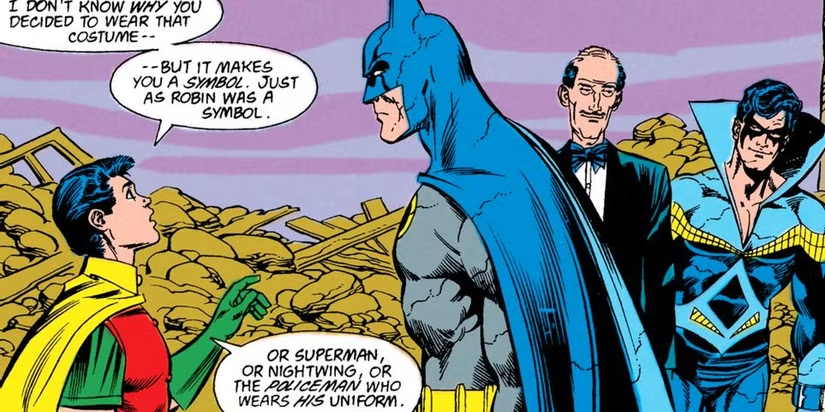
The standout sequence arrives near the end when Tim finally confronts Bruce, not to ask for the Robin role but to argue that Batman structurally requires one, that the darkness Bruce has been operating in since Jason's death is not sustainable and that Robin exists not as a sidekick but as a necessary counterweight. What makes the scene work is that Tim is not flattering Bruce or appealing to sentiment but making a genuine case rooted in his belief in Batman as a symbol rather than in any personal attachment to the man underneath. That distinction, between Tim loving what Batman represents and simply idolizing Bruce Wayne, is what separates him from both of his predecessors and gives his arc a quality that feels entirely his own.
A Lonely Place of Dying is not a flawless story, and the crossover format means it occasionally loses its footing in ways that a tighter, self-contained run would not have allowed. But as an introduction for Tim Drake, it succeeds where introductions most often fail, which is in making the case for why this person, at this specific moment, is the only one who could have stepped into this role. By the time he finally gets the suit and immediately takes a brick to the face within the first minute of wearing it, it feels unmistakably like the start of something rather than a replacement for what was lost. A strong 4 out of 5.
(He has been Robin for less than a minute and is already taking debris to the face. Some traditions start early.)