
V for Vendetta
Behind This Mask There Is More Than Flesh
DC/Vertigo ‧ Issues #1–10 ‧ 1988–1989 ‧ Alan Moore / David Lloyd ‧ 7 min read
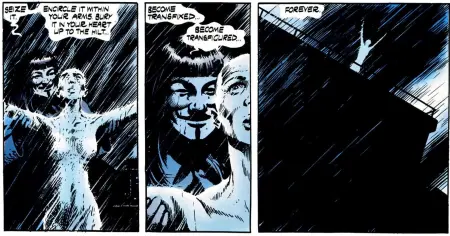
"You wear a mask for so long, you forget who you were beneath it."
V for Vendetta is set in a Britain that survived a limited nuclear exchange in the 1980s and then handed itself to a fascist government called Norsefire in the chaos that followed. By 1997, when the story opens, the people who did not fit that government's definition of acceptable Britain, meaning political opponents, immigrants, gay people, and artists, have already been processed through detention camps, and what remains is a population kept in line through surveillance, propaganda, and a secret police force. Alan Moore wrote it and David Lloyd drew it, beginning with a serialized run in a British anthology magazine called Warrior in 1982, and the decision they made at the start, to strip the comic of thought bubbles, caption boxes, and sound effects so that everything the reader knows comes through spoken word or image alone, shapes everything about how the book looks and feels. That discipline gives it a surface tension and a visual weight that most comics never achieve.
Into this world comes V, a masked figure in a Guy Fawkes costume who begins systematically destroying the infrastructure of the government that built the camps, and who rescues a young woman named Evey Hammond from the secret police on his way to blowing up the Houses of Parliament. What follows is not a straightforward revenge story, though it contains revenge, and not a simple political allegory, though it is deeply political, but something considerably more uncomfortable about what it actually looks like to try to dismantle a system from the outside and what it costs the person doing the dismantling.
V himself is the most genuinely difficult protagonist in Moore's body of work, theatrical and articulate and committed to a philosophy of anarchy that he pursues with a consistency the book takes seriously even when it is honest about the violence it requires. He is also someone who has been through something in those camps that the story reveals gradually, and what he does with Evey across the middle section of the book is one of the most morally contested sequences in comics, an act that is simultaneously cruel and arguably the most honest thing anyone does to her in the entire story. Moore does not ask the reader to approve of V but to understand him, which is a harder and more interesting request.
Evey's arc is the emotional spine of the book, and it is more complex than the film adaptation ever made space for. She begins as someone trying to survive in a system that has already taken most of what mattered to her, and her relationship with V changes her in ways that are not comfortable or clean or easily summarized. The book is genuinely interested in the question of whether the freedom V is offering is freedom or just a different kind of captivity, and Evey is the character through whom that question is most honestly examined. By the time her story reaches its conclusion, she is not the same person she was at the beginning, and the book is clear-eyed about both what she gained and what that transformation required of her.
David Lloyd's art is the other major reason this book works as well as it does. Working largely in dark, atmospheric palettes with strong shadows and deliberately flat backgrounds that keep the focus on the figures in the foreground, Lloyd creates a visual world that feels simultaneously oppressive and strangely beautiful, which is exactly what the script needs. His version of the Guy Fawkes mask, which has since become one of the most recognizable symbols in global protest culture, reads differently on the page than it does in photographs or on film because Lloyd draws it as something that genuinely obscures rather than merely covers, and the effect is that V's face is never readable in the way that even masked characters in other comics usually are. You cannot tell from his posture or his eyes or the line of his jaw what he is feeling, which means that every scene with him carries a low-level interpretive uncertainty that Lloyd maintains across the full book.
The honest criticism of V for Vendetta is that the government characters, who occupy a significant portion of the page count across the middle of the run, are drawn with considerably less depth than V and Evey, and the sequences following the various members of Norsefire's leadership can feel like obligatory political scaffolding rather than story that earns its space. The fascist government is drawn clearly enough as a system of cowardice and self-interest, but the individuals running it rarely transcend their functions in the plot in the way that the book's two central characters do. This is partly a structural consequence of Moore having to rebuild momentum after the Warrior cancellation, and partly a choice to keep the ideological argument clear, but it means that the book is significantly more compelling in its personal story than in its political one.
V for Vendetta earns a 4.5 out of 5 and is worth reading even, or especially, if you have already seen the 2005 film, which softens the book's politics considerably and gives V a more conventionally heroic shape than Moore ever intended. The book is messier and more demanding than the film, and V is less easy to root for, and both of those things are exactly the point. Moore was writing about what it actually costs to want to tear something down, and he did not want the answer to be comfortable.
(The film is a good film. The book is asking something the film chose not to ask.)