
Maus
Here My Troubles Began
Pantheon Books ‧ Volumes I & II ‧ 1986 / 1991 ‧ Art Spiegelman ‧ 8 min read
"I was too depressed then to write. Also I felt that to have survived - to have made it to America - was enough."
Maus is a comic about Art Spiegelman interviewing his father Vladek about surviving the Holocaust, and it is also a comic about what it is like to be the child of someone who survived the Holocaust, and it is also a comic about the limits of what any representation of historical atrocity can honestly claim to do. It was serialized in a literary magazine called Raw between 1980 and 1991, collected in two volumes by Pantheon Books, and in 1992 it received a special Pulitzer Prize, the first comic to be honored in that way, which tells you something about how seriously the literary world took it and also something about how unprepared that world was to categorize what it had received.
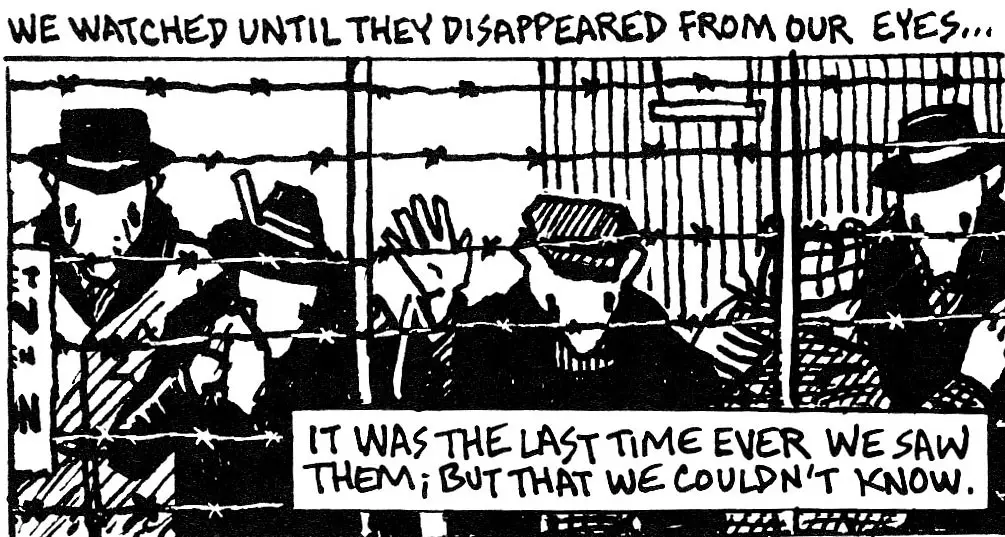
The central conceit of Maus is that it depicts different nationalities as different animals: Jewish people are mice, Nazi Germans are cats, Polish non-Jews are pigs, Americans are dogs. This is the detail most people know about the book before they read it, and it is also the detail that sounds strangest in description and feels most inevitable on the page, because Spiegelman is not using the animal metaphor to simplify or to make the horror more palatable but to acknowledge something true about how dehumanization works and to use the visual language of cartoons, a form historically associated with humor and childhood, in deliberate tension with subject matter that is neither of those things. The effect is not cute but deeply unsettling in a way that a purely realistic depiction might not be, because the gap between what you are looking at and what it represents never fully closes.
The book runs two timelines simultaneously, following Vladek in the past as he moves from his life in Poland before the war through the ghetto, the hiding, the camps, and the liberation, and following Art in the present, sitting with his elderly father in Queens and recording their conversations, navigating the relationship between a man who survived something unimaginable and a son who grew up in its shadow without fully understanding the weight he was carrying. What makes Maus extraordinary is that both timelines are treated with equal seriousness, and Art's story, which involves his guilt about his own work, his complicated feelings about his father, and the question of whether any artistic representation of the Holocaust can be justified, is as central to the book as Vladek's.
Vladek Spiegelman is one of the most honestly drawn figures in any memoir, and what makes him so is that Spiegelman does not protect him from the reader's judgment. Vladek is a Holocaust survivor, and the book never lets you forget what that means and what it cost, but he is also difficult, demanding, occasionally racist in ways that the book notes without editorializing, and possessed of a relationship to money and objects that his son finds exhausting and that the book shows you understanding completely once you have enough context for where it came from. He is fully human, which in a book about a dehumanizing historical event is both the correct choice and the most difficult one, because it means you cannot reduce him to a symbol of suffering or a purely sympathetic figure and be done with it.
The second volume, subtitled "And Here My Troubles Began," is where Spiegelman also breaks the fourth wall of the form most explicitly. There are pages where Art sits at his drawing board surrounded by the bodies of the dead, questioning what he is doing and whether it can be done without betraying the subject, and these pages are the most formally ambitious in the entire work because they pull you out of the story to ask whether the story should exist at all. Spiegelman is genuinely working through that problem rather than staging it, and the fact that he includes the working-through rather than presenting the finished result as a confident statement is what separates Maus from lesser memoirs of any kind.
Spiegelman's linework is deliberately spare, his mice expressively minimal, and that simplicity is a choice rather than a limitation, because it keeps the visual register of the book from becoming emotionally overwhelming at the moments when the content is at its most harrowing. There are pages in the Auschwitz sections that depict things which, rendered with photographic realism, would be difficult to look at directly, and Spiegelman's approach instead keeps them legible and present without turning them into horror imagery, allowing the reader to remain with what they are seeing rather than being pushed away by it.
Maus earns a 5 out of 5. Spiegelman could have made something easier and more consoling, and the fact that he chose instead to hold his own discomfort and complicity inside the frame at every step is what separates it from every other memoir the form has produced.
(Vladek throws out Anja's diaries. There is no clean way to feel about that, and Spiegelman does not try to offer one.)