
Marvels
The View From the Street
Marvel Comics ‧ Marvels #0–4 ‧ 1994 ‧ Kurt Busiek / Alex Ross ‧ 6 min read
"They were our marvels. Ours, and no one else's."
Every event in Marvels is something a Marvel reader has already seen. The Human Torch's debut in 1939. The Fantastic Four. The public turning on mutants. Galactus darkening the sky above Manhattan. Gwen Stacy falling from a bridge. Kurt Busiek is not retelling these moments to offer new information. He is asking the one question fifty years of superhero comics had almost entirely avoided: what did it actually feel like to be standing on the street when they happened?
The answer comes through Phil Sheldon, a news photographer, and his ordinariness is the entire point. He is not a scientist or a soldier. He is a man with a camera and a family, trying to make sense of a world that stopped making ordinary sense around the day a man made of fire flew over New York Harbor. He ages across the four issues, loses the vision in one eye, watches his daughters grow up, and carries the tiredness of someone who has spent his whole career standing just outside the frame of things he cannot fully understand. Phil is not a proxy for a hero. He is a proxy for the reader, except the reader has never been asked to sit with that position this honestly before.
What makes Marvels feel like a real contribution to Marvel history rather than just a love letter to it is that it takes the public's fear and resentment of superheroes seriously. The Daily Bugle calling Spider-Man a menace. The mutant registration debates. The way ordinary people scatter when the Hulk appears. These things existed in every issue as background noise, something to move past on the way to the real story. Marvels puts them at the center. The mutant hysteria in the second chapter is the clearest example because Busiek refuses to give Phil a comfortable distance from it. He has to confront his own participation in a fear he knows is irrational but feels anyway, and the scene where he eventually shelters a group of frightened mutant children hits harder because of it.
Marvels is also not embarrassed to be a comic, and that matters more than it might sound. It does not reach for grim self-seriousness and it does not treat the mythology as something that needs to be cleaned up or apologized for. The Human Torch flying over the harbor is painted with genuine wonder. The Fantastic Four are rendered with the same awe that Lee and Kirby were trying to put across on newsprint decades earlier. The book loves what Marvel comics actually are, and that pride is visible on every page. That is rarer than it should be.
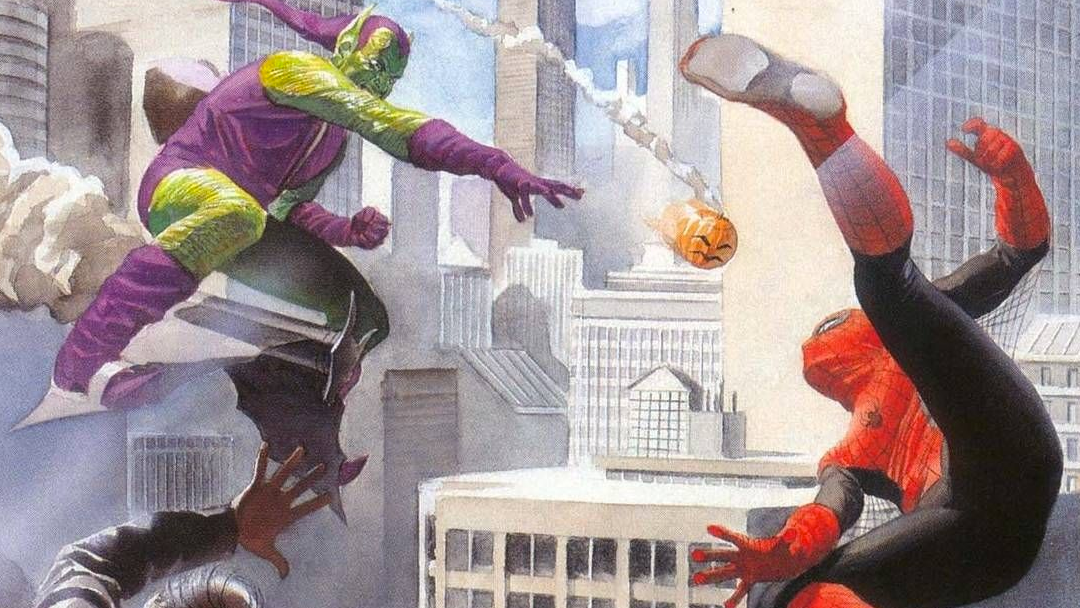
Alex Ross's painted art is what makes all of this land. His work is photorealistic in a way that removes the abstraction the medium usually relies on, and the effect is immediate. When Ross paints a crowd watching the Fantastic Four return from space, every face in that crowd has individual weight. The bystanders are not backdrop. They are as specific and present as the heroes above them. His Silver Surfer arriving ahead of Galactus is genuinely unsettling in a way cosmic threats rarely are, because Ross puts him in a visual language the brain reads as real. The heroes look like they actually exist. That sounds simple, but it quietly reframes everything around them.
The Galactus chapter is where the book makes its fullest argument. Phil is on the street when Galactus arrives, and what Busiek captures is not heroism but paralysis. Nobody knows what is happening. Nobody knows if the Fantastic Four can stop it. Phil only has what he can see from the ground, which is a sky that has turned the wrong color and a silence that has settled over a city that does not know if it will survive the afternoon. The resolution arrives without fanfare because Phil never witnesses it directly. The world just continues. There is more in that restraint about what it means to be ordinary in an extraordinary world than most comics manage in an entire run.
The final chapter, built around Gwen Stacy's death, is the most difficult and the most earned. Busiek has spent three issues having Phil photograph Gwen, observe her from a distance, and quietly treat her as a symbol of everything the marvels are supposed to be protecting. Her death does not arrive as a famous story beat the book is paying tribute to. It arrives as a personal loss, filtered through a man who had decided she represented something worth believing in. Phil's withdrawal afterward, his inability to reconcile a lifetime of documented heroism with the fact that it failed the one person he had chosen to believe in most, is the most honest emotional moment in the book.
Newer editions come with extensive annotations identifying every character, event, and Marvel reference embedded in Ross's paintings, and they reveal just how much is actually in there. Characters appear in background crowd scenes who had decades of their own publication history. Events are depicted that most readers would only recognize if they grew up with the source material. The annotations make all of it accessible without making it feel like homework. This is also part of why Marvels works so well as a starting point for someone coming from the MCU films. You already know these characters in one version. Marvels shows you where the feeling behind them originally came from, and it does it in a way that makes you want to go read those original stories yourself. That is exactly the right instinct to leave someone with.
The one honest limitation is that the outsider perspective, the book's greatest strength, occasionally keeps it at a slight remove from its own stakes. Phil witnesses rather than participates, and there are moments in the middle chapters where it feels closer to a guided tour than a story with its own urgency. It recovers, and the final chapter earns everything that came before it. Marvels gets a 5 out of 5. Busiek and Ross commit to their idea completely, even when that commitment costs the book momentum, and that discipline is what separates something that actually respects its own premise from something that quietly abandons it when things get hard.
(Work at the Bugle next day must have sucked.)