Spider-Man
The one I keep coming back to
Action/Sci-fi ‧ 121 minutes ‧ PG-13 ‧ 2002 ‧ 6 min read
“With Great Power Comes Great Responsibility”
Spider-Man is my favorite movie. I have tried to come up with more complicated ways of saying that, but there really is not much point. I know the movie has flaws. I know the CGI looks dated in places, the Green Goblin suit is ridiculous, and casting people in their late twenties as high school students was never going to age particularly well. None of that changes how I feel about it. There is something about this movie that still works for me in a way very few movies do.
I think the reason is pretty simple. Spider-Man actually cares about Peter Parker. Before he becomes the guy swinging around New York, he is just an awkward kid who feels like he is on the outside of everything. Tobey Maguire plays Peter as quiet and uncomfortable without making him completely miserable to watch. He is smart, he is funny in his own way, and he clearly wants more from life than what he has. When he gets his powers, it makes sense that he would be excited. For once, Peter gets to be the person people notice.
I also like that the movie lets Peter enjoy that for a while. The early power scenes are basically a kid figuring out what his new body can do. He tests his strength, climbs walls, tries to figure out his web shooting, and starts thinking about what he could do with all of this. It is probably the closest Peter gets to living out the fantasy of being Spider-Man without thinking about what comes next.
Then Uncle Ben dies, and the entire movie changes. What I like about Peter's origin here is that he does not become Spider-Man because someone tells him he has to. He makes a mistake, loses someone because of it, and spends the rest of the movie trying to live with that decision. That guilt is the thing that turns Peter into Spider-Man. The powers are just the tool.
That idea carries into the rest of the trilogy. Spider-Man 2 is basically the next question: what happens when Peter starts wondering whether he can keep paying the price of that decision? He has a job, school, relationships, and a life that he can barely hold together, but he still feels responsible for helping people. Spider-Man 3 should have taken that same idea and brought it to a conclusion. Even when that movie goes off in every possible direction, the reason those later stories matter at all is because this one established what being Spider-Man means to Peter.
Willem Dafoe's Norman Osborn is still my favorite written villain in this trilogy. The Green Goblin costume has become a meme for a reason, but Dafoe is so committed to the role that I can mostly look past it. Norman can be funny, friendly, threatening, and completely insane within the same conversation. More importantly, he is not just there because the movie needs someone for Spider-Man to punch. His relationship with Harry makes the whole thing more personal, and his obsession with power gives Peter a villain who represents almost the exact opposite of what Peter is trying to become.
That is something I appreciated even more after revisiting Spider-Man 2. Doctor Octopus is probably the better physical villain. The fights are better, the mechanical arms are incredible, and Alfred Molina makes Otto extremely sympathetic. But Norman is still the better written character to me. His story is tied into Peter and Harry from the beginning, and by the end the fight is not really just Spider-Man versus the Green Goblin. It is Peter trying to protect the people he loves from someone who has completely lost himself.
The supporting characters are a huge reason the movie still works. Harry is not just Peter's best friend. He is also Norman's son, which creates a really uncomfortable tension once Peter discovers what Norman has become. Aunt May is the person Peter turns to when he has nowhere else to go. Mary Jane is the person he loves but never quite believes he can have. Even Flash, who is mostly there to be the school bully, helps establish how isolated Peter feels at the beginning.
Mary Jane is probably the weakest part of the movie for me. Kirsten Dunst is good, and I like the relationship more than I dislike it, but the writing does not always give MJ enough to do. She gets stuck in a lot of the same soap opera drama involving Peter and Harry, and the movie leans heavily on her becoming someone Spider-Man needs to rescue. There is more to her character than the movie lets us see.
But when the Peter and MJ stuff works, it really works. Their relationship feels like something Peter has been carrying around for years. He is not just attracted to her because she is pretty. He knows her. He grew up with her. He has watched her life from the sidelines and convinced himself that he cannot be part of it. The upside-down kiss became iconic for a reason. It is cheesy, but the movie is completely sincere about it.
That sincerity is probably the biggest reason I still love this movie. Spider-Man is not embarrassed to be a comic book movie. Raimi lets the world be bright and weird and dramatic. Characters talk like comic book characters. The camera swings around Peter during action scenes. The score goes huge. Someone can be thrown through a window one minute and then have a genuinely heartfelt conversation the next. I know some of that can look silly now, but I would rather watch something completely committed to what it is than something constantly trying to make itself look too cool to care.
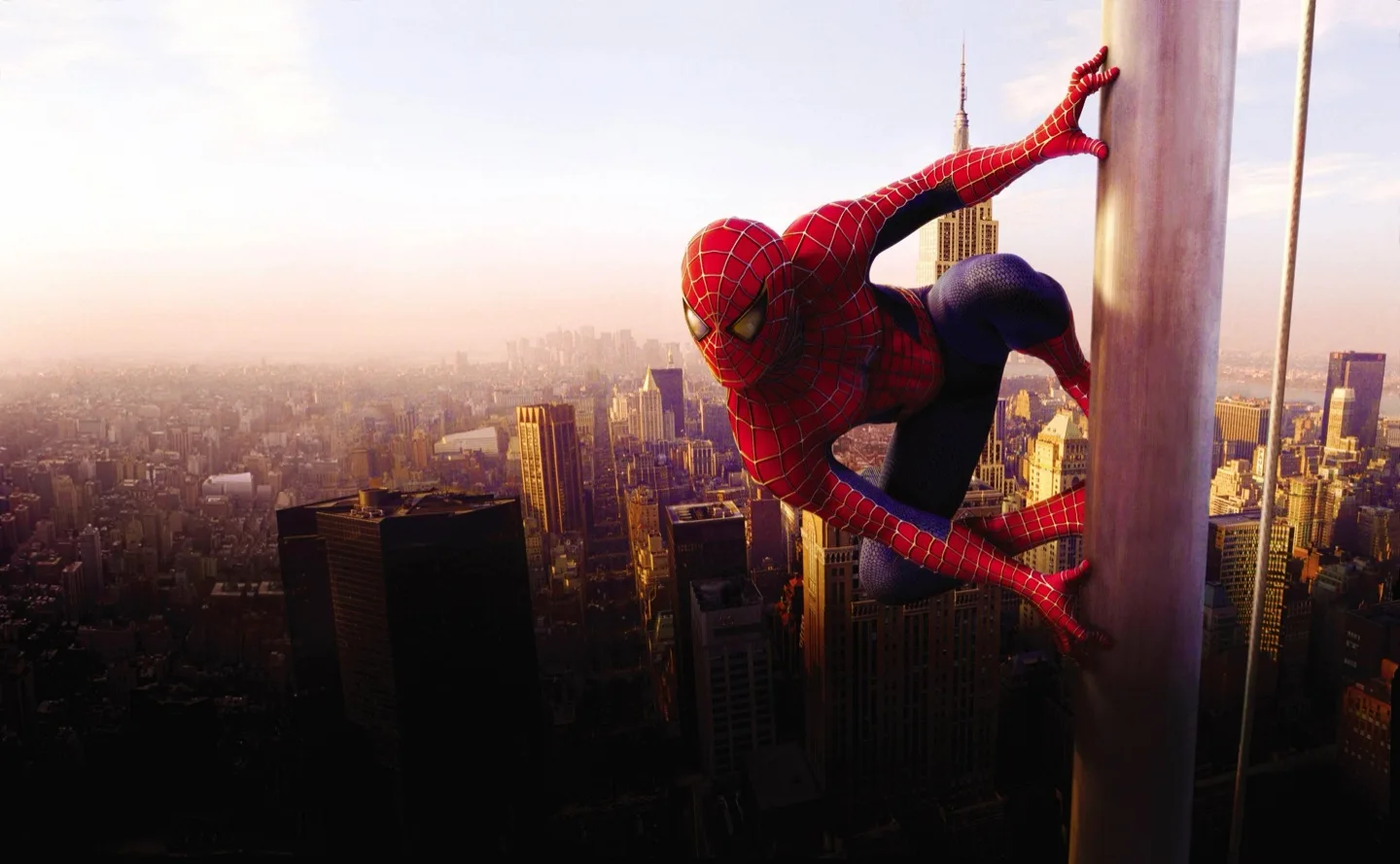
The CGI has obviously aged. I am not going to pretend the web swinging looks as convincing as it does in Spider-Man 2 or later Spider-Man movies. Even so, Raimi's direction makes the action work. He knows where to put the camera, when to let the actors sell a moment, and when the action needs to slow down. The final swing through New York is still one of my favorite moments because it feels like the first time Peter has completely accepted who he is.
I also think the movie gets the sadness right. Peter loses Uncle Ben. He watches Harry spiral because of Norman. He spends most of the movie believing that being Spider-Man means giving up the life he actually wants. Even when he wins, he does not get everything back. That is part of why the movie has stayed with me. Peter does not become a hero and suddenly get rewarded for it. He becomes a hero because he decides that helping people matters even when it makes his own life worse.
Spider-Man 2 takes that idea and makes it more complicated. It is probably the stronger movie in terms of filmmaking. The action is better, the effects are better, the cinematography is better, and Doctor Octopus is an incredible villain. I gave it a 4.5/5 for a reason. But Spider-Man is still the one I prefer. There is something about watching Peter become Spider-Man for the first time that the sequel cannot recreate.
And then Spider-Man 3 shows what happens when that simple idea gets buried under too many other ideas. Harry, Sandman, Venom, Gwen, the black suit, Peter and MJ, Peter's anger, forgiveness, and everything else are all fighting for the same two hours. Compared with that, Spider-Man is almost shockingly straightforward. It knows what story it is telling.
I do not think Spider-Man is perfect. I think it is my perfect Spider-Man movie. Those are different things. There are things I would change if I were making it today, and there are parts that have obviously aged. But the core of it is still there. Peter Parker is a kid who gets an incredible amount of power and has to figure out what kind of person he wants to be. He makes mistakes, loses people, and keeps trying anyway.
Spider-Man gets a 5/5 from me. Spider-Man 2 may be more accomplished, and Into the Spider-Verse would eventually prove that there are completely different ways to tell a great Spider-Man story, but this is still the movie I come back to first. It is the movie that made this character feel real to me, and after all these years, I still think there is something special about that.
(I know Spider-Man 2 is technically better. I just like this one more.)