Every Star Wars Movie, Ranked
No matter what anyone says, this film series is the single reason Hollywood is as big as it is
Star Wars is the reason Hollywood exists the way it does. That is not a small claim, but it is not an exaggerated one. The 1977 original rewired what studios thought a blockbuster could be, what audiences would pay to experience, and what mythology could look like when filtered through science fiction and borrowed archetypes. Everything that followed, every franchise, every cinematic universe, every summer tentpole, traces some lineage back to that film. For better or worse.
What makes ranking the Star Wars films an interesting exercise is how dramatically they vary in quality across a relatively consistent tonal universe. The original trilogy is among the most beloved in cinema history. The prequel trilogy is a complicated mess of ideas, half of which work beautifully and half of which do not survive the screenwriting. The sequel trilogy is a franchise in conflict with itself. And scattered throughout are standalone films that range from quietly charming to completely misguided.
This is my ranking. This is where I land on eleven films across nearly fifty years.
Star Wars (1977)
The original remains the best, and rewatching it reminds you why. What George Lucas created in 1977 was not just a film but a complete world, fully inhabited, richly detailed, and immediately alive in a way that most fantasy settings never achieve. Luke Skywalker's arc from restless farm boy to reluctant hero is one of the cleanest and most satisfying in the genre, precisely because it is so simple. The characters feel like real people in an impossible place. John Williams delivers one of the most recognizable scores in movie history. The practical effects carry a weight that digital production rarely replicates. And the story knows exactly what it is and commits to that fully. No film in this series has come close to recapturing what this one did, and few films in any genre have.
The Empire Strikes Back (1980)
The Empire Strikes Back is the rare sequel that understands its job is not to top the original but to complicate it. The Rebellion loses. Han is frozen in carbonite. Luke learns that the villain he is meant to destroy is his father, and he cannot even face that revelation without losing a hand. The film refuses to offer resolution, and that refusal is exactly why it is so powerful. Irvin Kershner brings a tonal seriousness that Lucas's own direction sometimes struggles to maintain. The Battle of Hoth is still one of the great action set pieces in blockbuster cinema. And Yoda, practical puppet, performed by a puppeteer, no CGI, remains more expressive than most digital characters made in the decades since.
Return of the Jedi (1983)
Return of the Jedi gets unfairly punished for not being Empire. Taken on its own terms, it is a strong conclusion to a remarkable trilogy. The throne room confrontation between Luke, Vader, and the Emperor is the emotional and thematic payoff of everything the original trilogy built, and it still lands. Luke's refusal to strike down his father is the defining moment of his arc, choosing compassion over vengeance at the exact moment victory would justify the opposite. Yes, the Ewoks are controversial. Yes, the pacing sags in places. But the film's final thirty minutes are among the best in the series, and that carries real weight.
Solo: A Star Wars Story (2018)
Solo is a film that arrived under terrible circumstances and deserved better than it got. The production was famously troubled, the marketing was flat, and audiences stayed home in numbers that surprised everyone. What is actually on screen is a genuinely fun heist adventure, loose, confident, and much less burdened by franchise obligation than most Star Wars films. Alden Ehrenreich is more charming in the role than the discourse ever gave him credit for, and Donald Glover's Lando is exactly as magnetic as you would hope. Solo does not ask deep questions or try to be mythic. It just tries to be a good time, and mostly succeeds.
Star Wars: The Last Jedi (2017)
The Last Jedi is genuinely divisive in ways that make it more interesting than most Star Wars films, not less. Rian Johnson deliberately subverts expectations, about Rey's parents, about Luke Skywalker, about what heroism means when institutions fail, and some of those subversions land with real force. Mark Hamill's Luke is a broken, complicated version of the character that the franchise had never attempted, and the payoff of his arc in the film's final act is moving in a way no sequel had managed. The Canto Bight subplot drags. The film is too long. But its ambitions are serious, and it is one of the few Star Wars films since the original that seems interested in saying something.
Star Wars: The Force Awakens (2015)
The Force Awakens does exactly one thing wrong and one thing right. What it does wrong is recycle A New Hope's structure so closely that the similarities become impossible to ignore, the desert orphan, the droid with hidden information, the superweapon, the mentor death. What it does right is introduce three new characters with genuine charisma and chemistry. Rey, Finn, and Poe are interesting people, and watching them interact carries real energy. The problem is that the film does not trust those new characters enough to build a new story around them. It plays it so safe that the sequel has nowhere to go, a problem The Last Jedi tried to solve and The Rise of Skywalker ran away from.
Rogue One: A Star Wars Story (2016)
Rogue One has a genuinely good idea at its center, the people who die so that heroes can win deserve their story too, and it fumbles the execution just enough to keep that idea from fully landing. The first two acts are scattered and rushed, introducing characters without giving the audience time to care about any of them. The third act, however, is spectacular. The Battle of Scarif is the best pure Star Wars action sequence in the sequel era, and the Vader hallway scene at the end is a moment audiences needed to see. Rogue One ends well. It just takes longer to get there than it should.
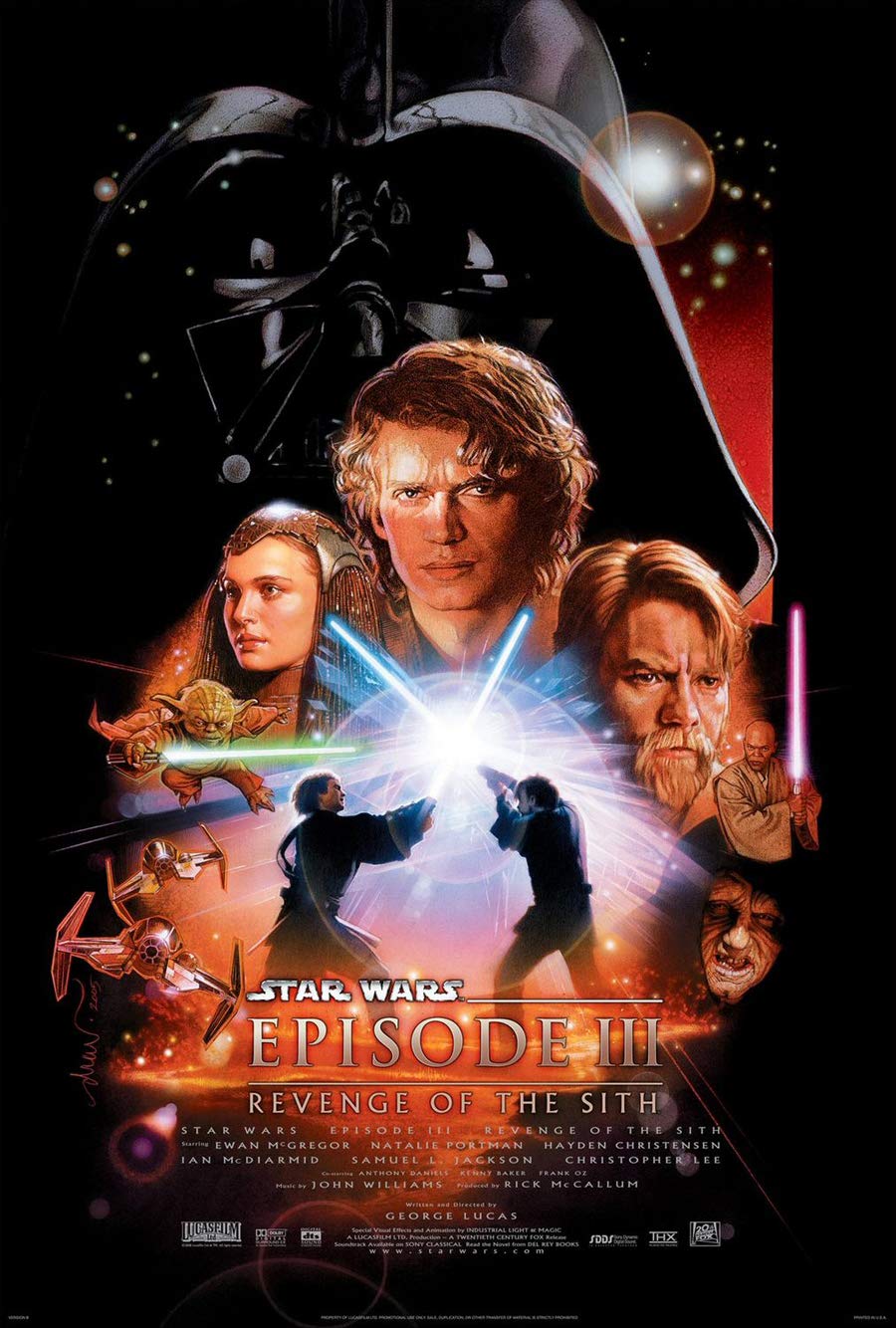
Star Wars: Episode III, Revenge of the Sith (2005)
Revenge of the Sith occupies a strange position, widely regarded as the best of the prequel trilogy, which is a claim that is difficult to argue against, yet one that comes with an unspoken caveat. Being the strongest entry in a flawed set does not automatically make it great. The ingredients for Anakin's fall are all present: fear of loss, wounded pride, and Palpatine's patient manipulation. But they are treated as checkboxes rather than an evolving psychological collapse. We are told he is conflicted but rarely allowed to live inside that conflict. Ewan McGregor and Ian McDiarmid do the best work in the film, and John Williams turns in one of his finest scores. The machine works. It just rarely breathes.
Star Wars: Episode I, The Phantom Menace (1999)
The Phantom Menace is a film that clearly excited someone somewhere during production, but the film on screen has a strange lifeless quality that is hard to explain and harder to sit through. The trade dispute plot is not inherently a bad idea, Star Wars mythology benefits from political texture, but the execution is so dry that it registers as noise. Qui-Gon Jinn is one of the most interesting characters in the saga, and Liam Neeson's quiet authority makes him compelling even when the writing fails him. The pod race is still thrilling. Duel of the Fates is still one of Williams's best. The rest is a film that seems uncertain what it wants to be.
Star Wars: The Rise of Skywalker (2019)
The Rise of Skywalker is what happens when a franchise panics. J.J. Abrams was brought back to walk back decisions made in The Last Jedi, and the result is a film in constant retreat, from subversion, from ambiguity, from anything that might upset the loudest part of the fanbase. Palpatine returns without explanation because the film needed a villain and had burned its bridges with Kylo Ren. The plot moves at a frantic pace not because the story demands urgency but because slowing down would require the film to explain itself. The character dynamics that the sequel trilogy spent two films building are largely discarded. It is a film made by committee for the purpose of damage control, and it shows in every scene.
Star Wars: Episode II, Attack of the Clones (2002)
Attack of the Clones is the low point of the saga, and it holds that position without serious competition. The romance between Anakin and Padme, the emotional core the entire prequel trilogy depends on, is so stiffly written and awkwardly performed that it undermines everything around it. The sand speech is not a meme. It is a symptom. No actor could have sold those lines, and Hayden Christensen and Natalie Portman are given no directorial help in the attempt. The Obi-Wan investigation subplot is genuinely interesting and suggests a different, better film hiding somewhere in the production. The action sequences, particularly the arena battle, have scale and energy. But none of it survives the romance, which the film cannot stop returning to. This is the one Star Wars film that is simply difficult to defend.
No matter what the bottom of this list looks like, the original trilogy earned Star Wars its place in history, and no number of disappointing sequels can take that away. The first film gave Hollywood a template. The best of its sequels proved the template could be exceeded. That is more than most franchises ever manage, and it is worth remembering every time the latest entry disappoints us.