
Star Wars: Episode III - Revenge of the Sith
Best of the prequels, but that’s a low bar
Action/Sci-fi ‧ 140 minutes ‧ PG-13 ‧ 2007 ‧ 5 min read
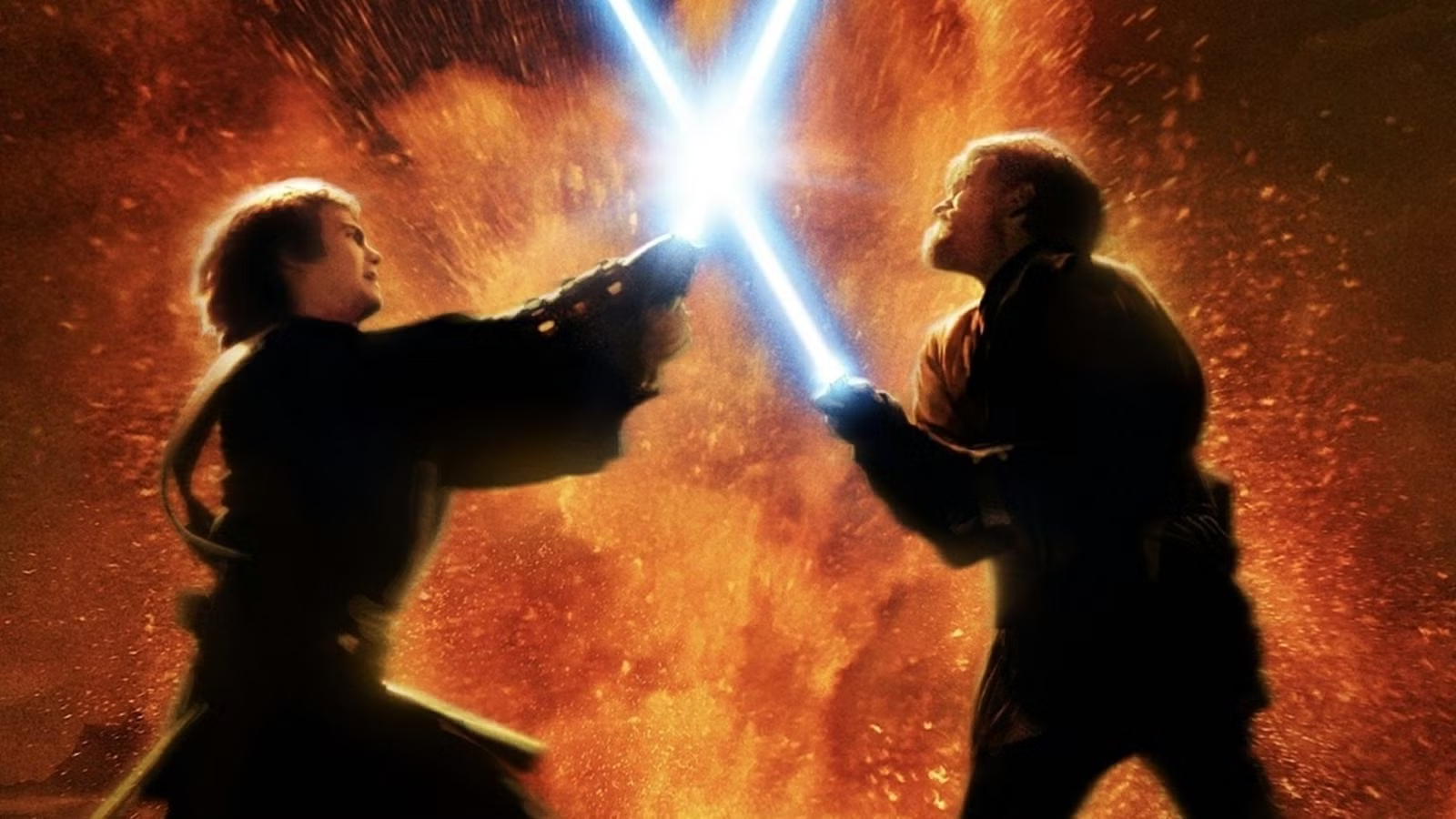
“You were the chosen one!”
Revenge of the Sith occupies a strange position within the Star Wars saga. It is widely regarded as the best of the prequel trilogy, a claim that is difficult to argue against, and yet that praise comes with an unspoken caveat. Being the strongest entry in a flawed set does not automatically make it great. Directed once again by George Lucas and starring Ewan McGregor, Hayden Christensen, Natalie Portman, and Ian McDiarmid, the film is technically accomplished, thematically ambitious, and emotionally restrained in ways that ultimately hold it back.
At its core, Revenge of the Sith is burdened by inevitability. This is the film that must bridge two trilogies, collapse years of lore into a single arc, and rearrange the board so the original Star Wars can begin. Lucas approaches this task with efficiency, sometimes impressively so, but often at the expense of emotional credibility. The plot moves cleanly from point to point, yet the people inside it rarely feel like they are moving of their own accord. Everything functions; very little breathes.
Anakin Skywalker’s fall to the dark side is the film’s central tragedy, and also its greatest weakness. The ingredients are all present: fear of loss, resentment, wounded pride, and Palpatine’s long, patient manipulation. However, these motivations are treated more like checklist items than an evolving psychological collapse. Anakin turns not through gradual erosion, but through narrative necessity. Scenes that should feel like moral pressure accumulating over time instead play as abrupt shifts in allegiance. We are told he is conflicted, but we are rarely allowed to live inside that conflict long enough for it to fully register. The result is a transformation that feels assigned rather than earned, a tragedy we are expected to accept rather than experience.
The supporting cast fares unevenly. Obi-Wan Kenobi is the emotional anchor of the film, and Ewan McGregor brings a weary sincerity to the role that consistently cuts through the stiffness of the dialogue. Still, even his arc is constrained by structure. The decision to separate him from Anakin during the most critical phase of the fall makes sense within the story’s logic, but it robs the film of the very relationship it most needs to interrogate. Padmé, meanwhile, is largely sidelined, reduced to silent concern and passive heartbreak, watching events unfold from balconies and corridors rather than shaping them in any meaningful way.
Much of the script feels simultaneously overcrowded and underwritten. There is an abundance of lore, political maneuvering, and Jedi Council debate, yet very little of it deepens character. Conversations often function as narrative pit stops between set pieces, conveying information without emotional momentum. Dialogue sounds important without actually changing anyone involved, leaving characters to feel more like vessels for exposition than people reacting to a rapidly collapsing world.
The action, by contrast, is relentless and meticulously staged. The opening rescue, the hunt on Utapau, Order 66, and the duel on Mustafar are all executed with technical precision and visual clarity. Individually, these sequences are impressive. Collectively, they begin to blur together. Without a stronger emotional foundation, the spectacle loses impact through sheer repetition. When the film finally slows down, most notably during Obi-Wan’s anguished plea on the lava banks of Mustafar, it briefly finds the raw emotional truth it has been chasing. Unfortunately, it moves on almost immediately, eager to complete the next obligation.
The problem is not a lack of Darth Vader on screen, but a lack of interiority. Vader emerges as a symbol fully formed, rather than a broken man we understand from within. Without a more convincing descent, the rise feels hollow. The infamous final scream only emphasizes this gap, attempting to inject emotion where the groundwork was never fully laid, and landing closer to unintended humor than heartbreak.
Still, the film is far from a failure. John Williams delivers one of his strongest Star Wars scores, with tracks like “Anakin’s Betrayal” and “Battle of the Heroes” doing more emotional work than many of the scenes they accompany. The music binds moments together, lending weight and coherence where the script sometimes falters. Even more effective is Ian McDiarmid’s Palpatine, a performance of quiet menace and theatrical confidence. His smiles, whispers, and calculated patience provide the film with its most consistent sense of danger, and his manipulation feels genuinely insidious in a way the broader narrative often does not.
Revenge of the Sith ultimately functions like a well-oiled machine. It delivers the required outcomes with speed, scale, and technical skill, but rarely with intimacy. It is the best of the prequels, yes, but that distinction carries limited weight. What remains is a film that looks and sounds monumental, yet often feels curiously empty at its center. I give it a rating of 2.5/5
(However, we can learn from our mistakes. The sequels proved that. Right?)